Sunday, March 13, 2016

Wool Applique

I have been playing a lot with wool lately. It is the perfect thing to take with me when I travel or even if I am waiting for an appointment! I can prepare my blocks ahead of time and keep them handy in a project bag with thread, needle, thimble and scissors.


Here are some tips:


When I applique with wool, I prepare the background fabric by ironing Formflex to the wrong side of the fabric. Formflex is a light-weight cotton with a fusible on one side and when it is affixed, it gives your fabric enough body to support the wool. You don’t need to put fabric in a hoop when you use Formflex.


I transfer my patterns onto freezer paper and cut them out using paper scissors. Then I iron the shiny side of the freezer paper to the wool pieces that I have chosen and cut them out using fabric scissors. If I am playing with circles, I love the pre-cut wool circles that we have at Sew Creative in 4 different sizes! Lately I worked with hexagons and we pre-cut those too using an Accuquilt Studio machine. We keep it in the office and use it whenever we want quick and accurately cut shapes.


I love using wool because it is so easy to work with. Our wool is hand dyed and felted in the process. This means that it does not ravel so I don’t have to turn under edges when I sew it down. Wool felt is a different product altogether. It is thinner than felted wool and doesn’t have the same loft. I prefer felted wool when given the choice.


So now I am ready for pinning. I love my applique pins because they are small so my thread rarely catches on them when I am sewing. I don’t like to use fusibles with wool because I find that they don’t stick well due to the thickness of the wool and the pins make it unnecessary to do the extra step of applying a fusible.


I like to use embroidery needles because they are easy to thread.  I hate trying to find the eye of the needle with some of the others! I use 2 strands of matching embroidery floss when I sew. The strands disappear into the wool and this allows me to come back in with thicker embroidery threads for embellishment later. I use a whip-stitch to sew my pieces in place but I know others who swear by the blanket or buttonhole stitch. The choice is up to you.


I love Sue Spargo’s Creative Stitching book for examples of embellishment stitches. We carry many of the threads she recommends and it is always hard to choose from all the lovely colors. I like playing with Sea Grass when I want my stitches to lay flat and contrast against my wool. I also love using silk threads because of their gorgeous colors, sheen and the way they show up against the wool.  


Lately I have been working on the next Block of the Month (using some of the hearts pictured here) and I have been embellishing with different trims and cording. It is easy to sew through these trims or over them to couch them down.


If I don’t have a specific quilt in mind then I just sew circles to each other. I love the way they look and someday they will become a quilt. In the meantime, my hands are busy and I am having fun.

Join me on the fourth Saturday of every month from 2 to 4pm for wool club.  I am happy to demonstrate stitches or answer any
questions. Wool Club participants receive 15% off on wool that day. It is a great way to get going on that wonderful wool project that has been calling to you…or just to sew with friends.


Sunday, February 21, 2016

New Fabrics and how to use them!

Hello all!
We have tons of new fabric in the shop! We're practically spilling out into the street!
Several of our fabrics are not mid-weight quilting cottons. Quilting cottons are great because they are widely available, easy to work with and come in every print, color and texture imaginable. However, some other fabrics are just as stable and may work better for your projects.

Without further ado, here are some ideas, explanations and guidelines to get you sewing with the great fabrics we have in our store.


Cotton Sateen: a heavy weight fabric woven with a satin weave. A satin weave has a three-over, one-under pattern instead of a one-over, one-under pattern. This creates a slight sheen to the fabric. Cotton sateen is great for home decor projects and for bags, pot holders and other useful things.

Cotton Sateen 


Rayon and Voile


Rayon and Voile: lightweight fabric with tons of drape. These fabrics are very common in apparel sewing because they make great summer dresses, skirts and blouses. However, they are very stable fabrics. They would make a lovely lightweight summer quilt as well.


Corduroy
Corduroy: is a heavier fabric with long ribs running along it called the "wale". There can be a large wale that would be great for kids overalls, or a small wale that you would see on pants for adults. Corduroy is a great bottom weight. Skirts, pants, over-shirts, or coats would all be lovely.  Corduroy has been used for years for clothing, however it can also be used for your quilting and crafting needs! Terry made a stunning corduroy quilt in lovely jewel tones and because it is a heavier fabric, it would also hold up in a tote bag or pillow cover. You could easily make a slip cover for your sofa with it or use it for potholders and neck warmers.
Corduroy


Linen/Cotton Blends: Unlike their pure linen counterpart, linen/cotton blends come without any of the drawbacks. They are heavy fabrics that don't wrinkle easily. We make lots of market bags combining vinyl mesh and lovely linen prints. However, the best part is that you can add them to your quilts! Terry used a gray polka dot linen fabric as the background for a Jen Kingwell quilt and its a showstopper!


Raw Silk or Silk Noil: This fabric takes a little getting used to because of it's texture and nubby feel, however it is one of my favorite fabrics. It is more stable than cotton, irons nicely and comes in lovely saturated colors.  You could use this fabric for absolutely anything: quilting, clothing, home decor and crafting. Fair Warning: it shrinks and bleeds. Throw it in your washing machine and dryer before you cut it and then you can wash it and dry it forever.

Raw Silk or Silk Noil
I hope this helps you understand fabrics better! Guest Post by Mahri.

What are your favorite non-quilting-cotton fabrics? Tell us in the comments below!

Sunday, February 14, 2016

Is your tension giving you a headache?

Getting the tension right on your sewing machine can be a real pain. Before you despair try these quick and easy fixes!

    Photo Credit: http://www.sew-inspired.com/2013_02_01_archive.html
  1. Clean the bobbin casing of lint! Even using good quality cotton thread, you will get a build up of lint in your casing.
  2. Photo Credit: http://huntingforladybugs.com.au/thread-sewing-machine/
  3. Re-thread your machine! Sometimes it gets off track and can severely mess up your stitching. Make sure your thread is going through every thread guide. Check that your bobbin is in correctly! This is crucial. Double check in your sewing machine manual how your bobbin is supposed to go in.
  4. Photo Credit: http://support.brother.com/
  5. Was your bobbin wound too slowly? If it is too loose or too tight you can have tension problems.
  6. Photo Credit: http://www.pumpkinpatchquilter.com/2013/01/a-little-about-thread-weight.html
  7. Check that the thread coming off your spool and from your bobbin is the same brand and color. Different weights and kinds of thread can cause big problems!
  8. Photo Credit: Sew Creative Ashland
  9. Do you have the right needle for the job? Needles differ greatly and we have a book that can help you choose the correct needle.
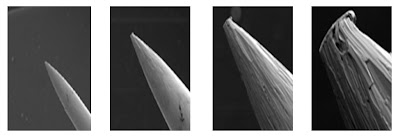
  10. Change your needle! Old needles will often cause tension problems.  If it's dull or has burrs it could mar your fabric too!

    Photo Credit: http://schmetzneedles.blogspot.com/2012/11/sewing-machine-needle-dull-needle-with.html      
  11. tension_image
    Photo Credit: http://www.kellyscreativesewing.ca/kellys_advice.htm
  12. Different weights of fabric require different tension settings. Play around with a scrap of fabric until the tension is right on your fabric. 


Do you have any quick fixes for tension issues? Let us know in the comments below!

Sunday, February 7, 2016

Sweet Tweets


This is a quick and easy project from the new book called Sweet Tweets. I made it in an evening using a cotton/linen blend for the background and lots of scraps.The birds are fused to the background and the free motion quilting is supposed to be a little wonky so you don't have to worry about being perfect! There are lots of cute patterns and it is hard to stop with just one!